
The Messiah Complex
Leonardi against the rest of the world

There’s a certain type of figure who emerges in times of crisis, convinced they alone can see the truth while the rest of the world stumbles in darkness. These self-anointed prophets claim to have been ignored, persecuted, or worse—silenced—by a grand, orchestrated effort to suppress their genius. What we have here is a textbook case.
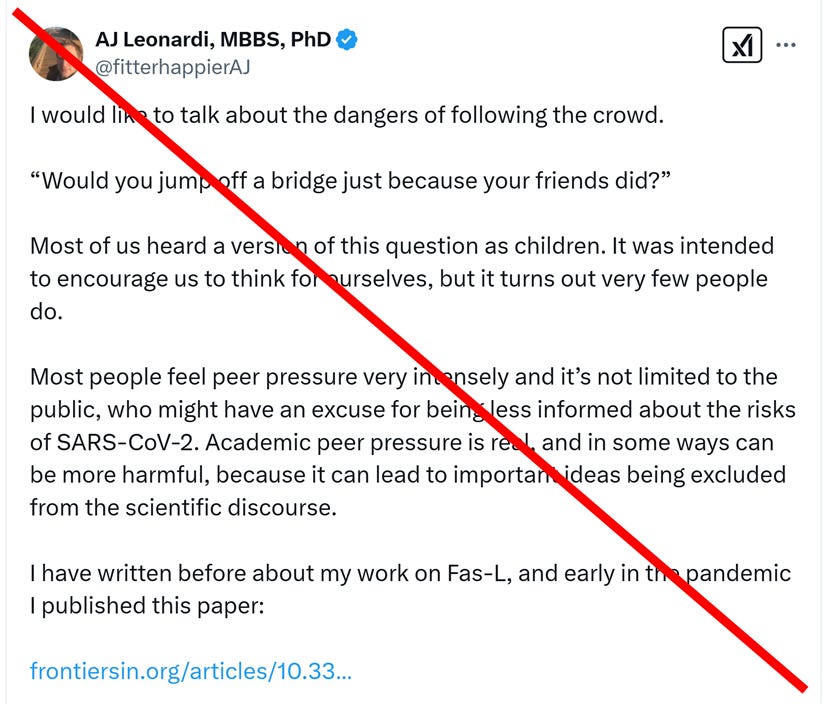
Let’s start at the core claim: the dangers of “following the crowd.” Of course, mindless conformity can be dangerous. But there’s an implicit assumption here that the alternative—rejecting consensus—automatically makes one correct. That is, quite frankly, nonsense. Sometimes the crowd is right. That’s why it’s the consensus. The claim that scientists are simply driven by peer pressure rather than evidence is not only laughably cynical, but also a gross misrepresentation of how scientific discourse actually works.
The author presents himself as a maverick who saw the dangers of COVID-19 and was ridiculed for it. But look past the self-pity and grandiosity, and a different picture emerges. This is someone who conflates being disagreed with—on scientific grounds—with being oppressed. His argument boils down to: “I was right about some things, therefore I am right about everything.” That’s not how science works. It’s not about being first, loudest, or most paranoid—it’s about being accurate, proportional, and evidence-based.
Now, let’s look at the actual scientific claims. The repeated insistence that reinfection with SARS-CoV-2 is always a “net harm” is a classic example of cherry-picking data to fit a predetermined conclusion. Yes, reinfections can carry risks, and yes, COVID-19 is a complex and serious disease. But the notion that each infection leads to inevitable immune system degradation in all individuals is hyperbolic fear-mongering, not rigorous science. Immunology is far more complex, with factors such as individual variation, vaccine protection, and the body’s ability to adapt and recover playing crucial roles. Yet these nuances are entirely missing from the alarmist narrative presented here.
The first paper is an opinion. It incorrectly assumes that SARS-CoV-2 infections result in lymphopenia (severe reduction in white blood cells called lymphocytes, which include B and T cells). This is not the case. In severe cases, especially those needing ICU there can be lymphopenia, just like this can happen with a variety of infections and trauma. It is not SARS-CoV-2 specific, nor is it a characteristic of the average SARS-CoV-2 infection. Certainly not after immune memory is established. Besides, papers show a return to physiological levels, although the timing can depend on the individual and disease severity.
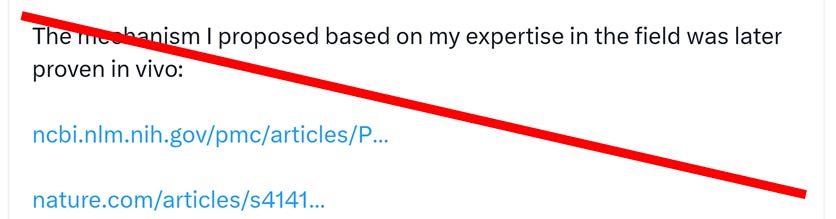
Paper two, is no validation of anything. It shows that soluble FasL, which is present in serum during severe infections, can be used as an indicator of severe infection with SARS-CoV-2 as well. That is all!
Paper three, shows that during a heavy infection, such as here SARS-CoV.2, there is a lot of cell death. That is again not SARS-CoV-2 specific but due to the severity of the infection in the cohort studied. The cohort in which this happens are the most severe cases: those requiring ICU.
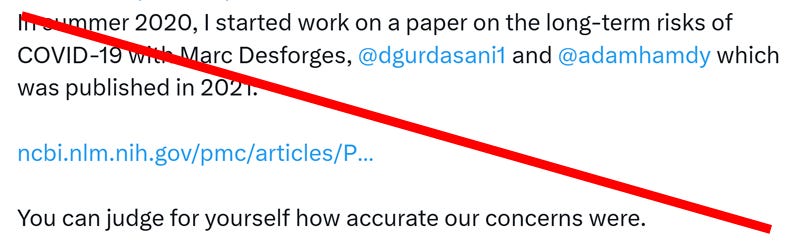
The fourth one, in an MDPI title, well it is the same opinion again. One that is incorrect and does not contribute primary data. ”there is more to COVID-19 beyond the acute infection” well… like for every infection there are risks involved with an infection, especially if there is no immune memory. SARS-CoV-2 is no exception. This happened, for the first time with a large scientific community, in an adult population. However, it follows the path as predicted from many animal studies and those in children. Immunity is build up.
The fifth, yes, another opinion piece. This seems as if repeating yourself over and over, will make you be correct. This is a lot of words that say and mean very little. It isn´t science.
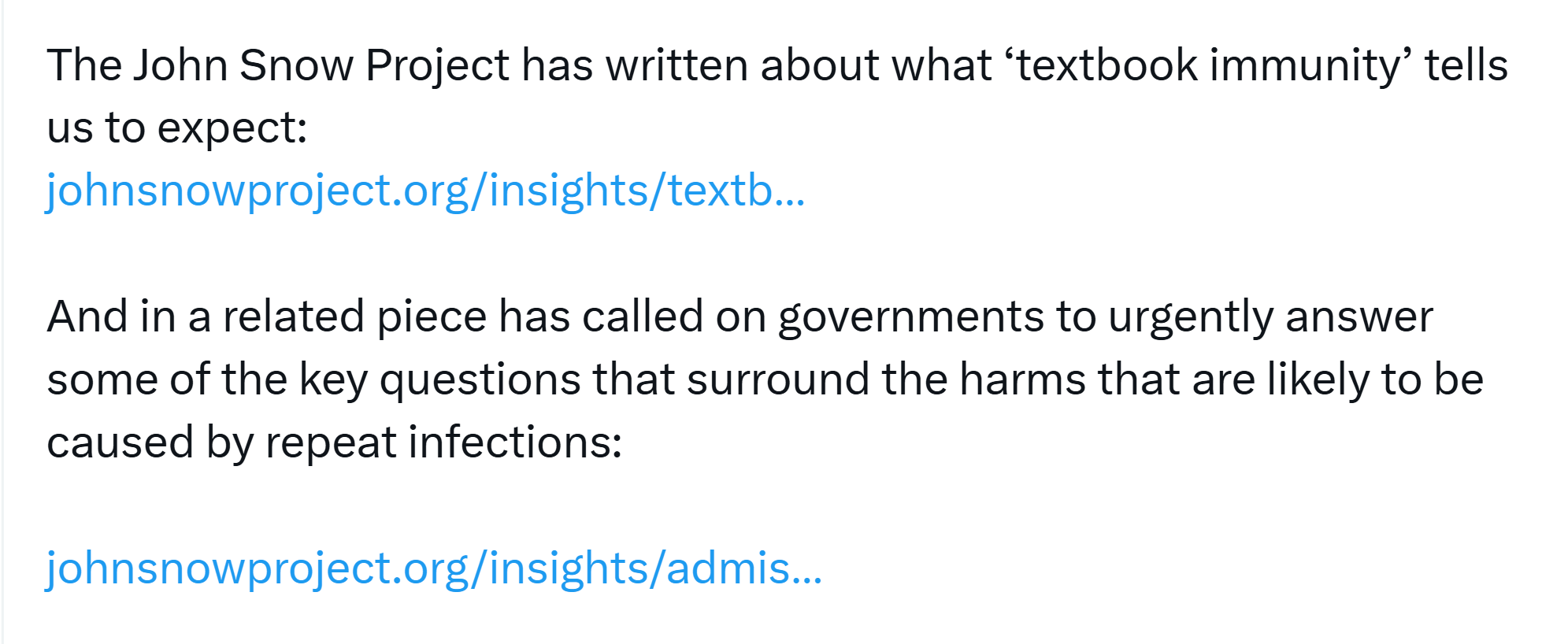
That “the John Snow project” took over these strange ideas, not rooted in science, is not as good an argument as the OP seems to think.
Then there’s the persecution complex. The claim that a cabal of scientists conspired to discredit the author, rather than simply engaging in normal academic disagreement, is the hallmark of someone who sees every critique as a personal attack. Instead of asking whether their theories, their methods, or their interpretations might be flawed, they assume a shadowy plot is at play. And writing to someone’s boss because they criticised you? That’s not the move of a serious scientist, it’s the move of someone desperate for validation.
Let’s not ignore the appeal to martyrdom. The author claims their career has suffered, that they have personally funded their own research, that he have endured social exile for his views. This is designed to evoke sympathy, but it is entirely beside the point. The correctness of a scientific claim is not determined by how much someone has suffered for it. People throughout history have faced pushback for bad ideas just as much as they have for good ones. Victimhood does not confer truth.
Finally, we get to the grand, sweeping conclusion: history will judge. The weight of responsibility is framed as being on “us” to heed the warnings of this one, lonely voice against a world that wants to move on. But here’s the thing: history will indeed judge—but it will judge based on evidence, not the volume of one’s proclamations, the number of Twitter spats one has endured or followers fooled.
There is a serious conversation to be had about the long-term impacts of COVID-19. There are real concerns that need addressing with respect to long-term impact of infectious diseases. LongCOVID could be the catalyser for this. But the disinformation and nonsense of these accounts undermine any serious science. This is not how you do it. What we have here is not a reasoned critique but a self-aggrandising narrative wrapped in pseudo-scientific fatalism. It’s the Messiah Complex in full effect—the belief that one person, against all odds, sees the full truth while the rest of the world is blind. And that, ironically, is the real danger of following a crowd—especially when that crowd consists of just one person.